
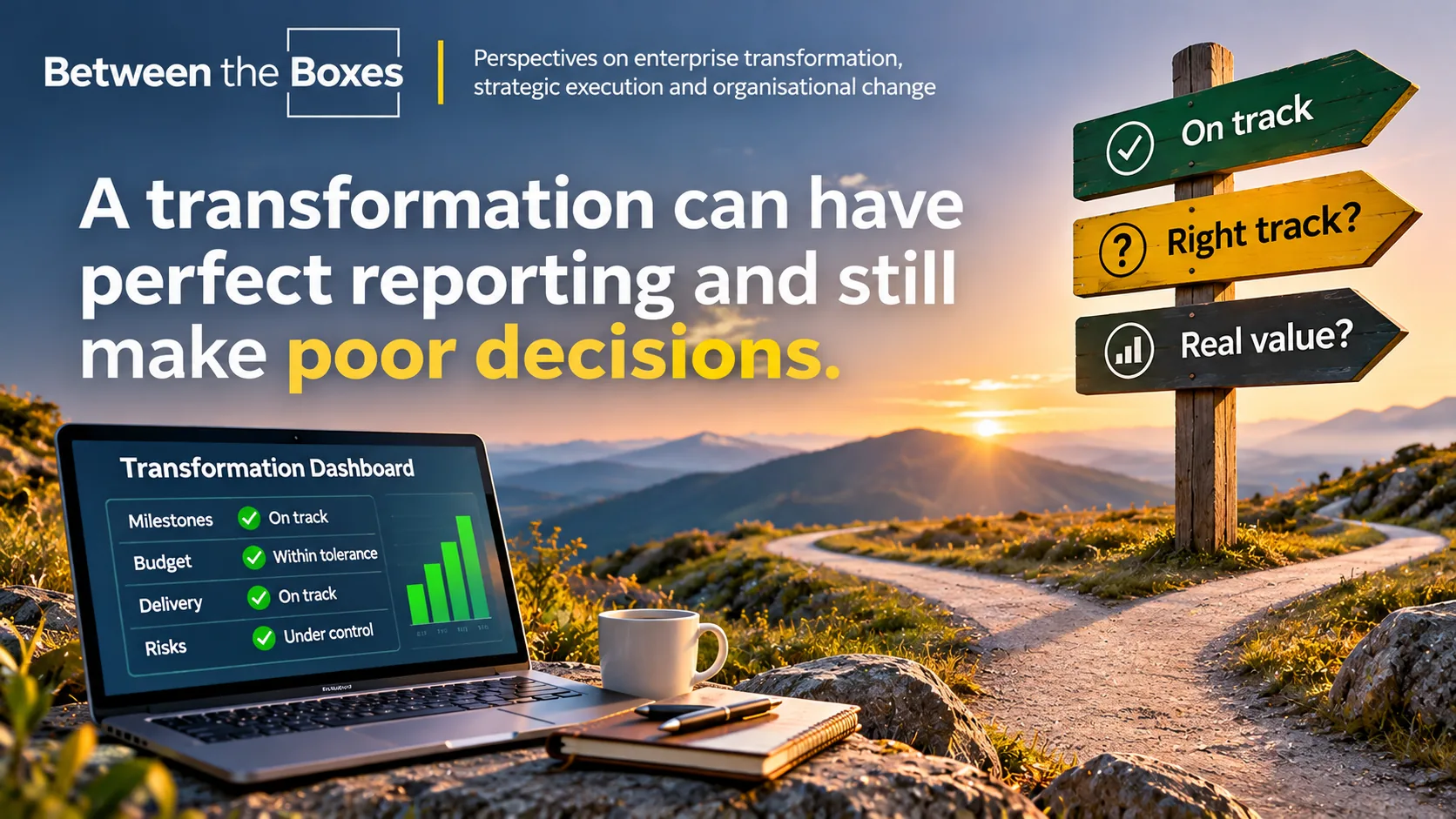
A transformation can have perfect reporting and still make poor decisions.
Between the Boxes | Enterprise transformation, strategic execution and organisational change
Originally published on LinkedIn on 5 November 2026.
Your transformation dashboard is green. But are you making the right decisions?
Everything looks reassuring. Milestones are on track. The budget remains within tolerance. Risks are documented. The steering committee receives its reports on time.
The transformation appears to be under control. But critical decisions may be postponed, dependencies unresolved and business priorities shifted without corresponding portfolio choices.
The reporting is accurate. The decisions may still be wrong.
Knowing what is happening is not the same as deciding what should happen next.
When reporting becomes a substitute for judgement
Good reporting matters. Organisations need visibility into delivery, expenditure, risk, dependencies and performance. Without reliable information, effective governance becomes much harder.
But even excellent reporting has a limitation. It describes a selected view of reality. It does not automatically resolve competing priorities, expose weak assumptions or determine whether an investment still deserves support.
A programme can be delivered according to plan while the original business case becomes less compelling. A portfolio can meet its quarterly delivery targets while its initiatives compete for the same scarce capabilities. A steering committee can receive increasingly sophisticated dashboards while avoiding the decisions that would materially change outcomes.
These are not necessarily reporting failures. They are failures to connect information with judgement, accountability and action.
Three questions that should never be confused
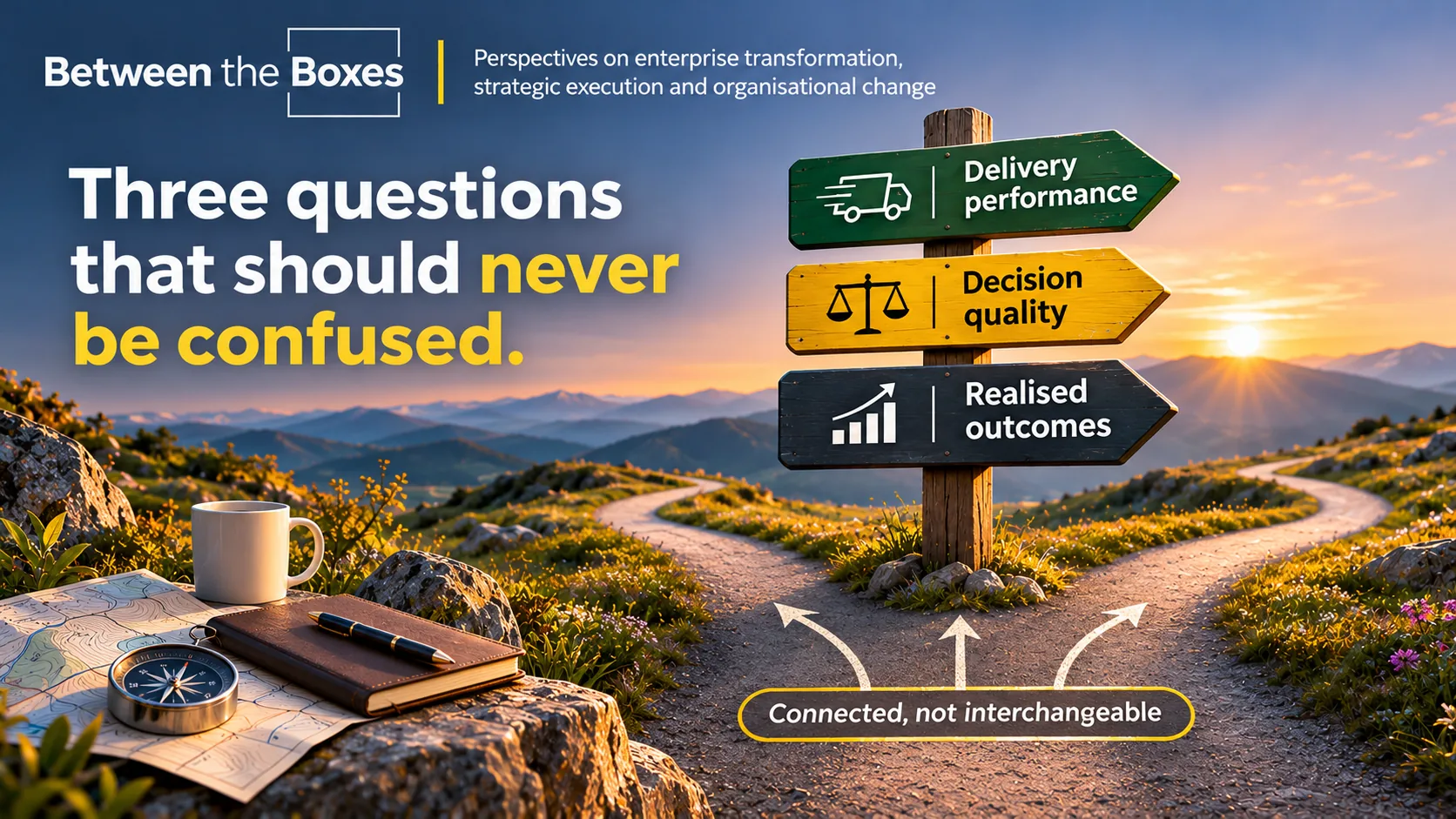
A more useful governance conversation distinguishes three questions.
1. Are we delivering what we agreed?
This is the traditional performance question. It concerns milestones, expenditure, scope, dependencies, quality and delivery risk. It tells us whether execution is progressing against the current baseline. Necessary, certainly. But not sufficient.
2. Are we still making the right decisions?
Are our assumptions still valid? Have priorities changed? Are dependencies creating risks that individual projects cannot resolve? Should we continue, adjust, accelerate, pause or stop?
This question requires leadership to examine choices rather than simply review progress.
3. Are we creating the outcomes that justified the investment?
Are the intended operational, financial, organisational or customer outcomes becoming visible? Who is accountable for achieving them? What evidence supports the expectation that delivered capabilities will translate into real benefits?
The answers may emerge long after the original project milestones have been completed. These questions are connected, but they are not interchangeable. A green delivery indicator cannot, by itself, answer the other two.
Why the distinction matters now
Enterprise transformations rarely operate in stable conditions. Technology changes. Strategic priorities evolve. Resources become constrained. Dependencies extend across organisational boundaries. The assumptions behind yesterday’s decisions may no longer hold.
The Project Management Institute’s Pulse of the Profession 2026 reports that 31% of complex projects do not realise the full scope of their originally intended benefits. Its research also emphasises outcomes over activity, alignment over compliance and learning over certainty. This finding describes benefits realisation, not simply missed delivery milestones.
The finding does not prove that reporting causes poor decisions. It reinforces a broader point: successful execution requires more than keeping individual workstreams on plan.
The UK’s National Audit Office has similarly emphasised how governance arrangements, organisational behaviours and timely decision-making influence major-project delivery. The Association for Project Management distinguishes the delivery of outputs from the subsequent realisation of benefits.
Transformation governance should not merely establish whether delivery remains under control. It should help leaders determine whether the organisation is still pursuing the right outcomes in the right way.
The decisions hidden behind a green dashboard
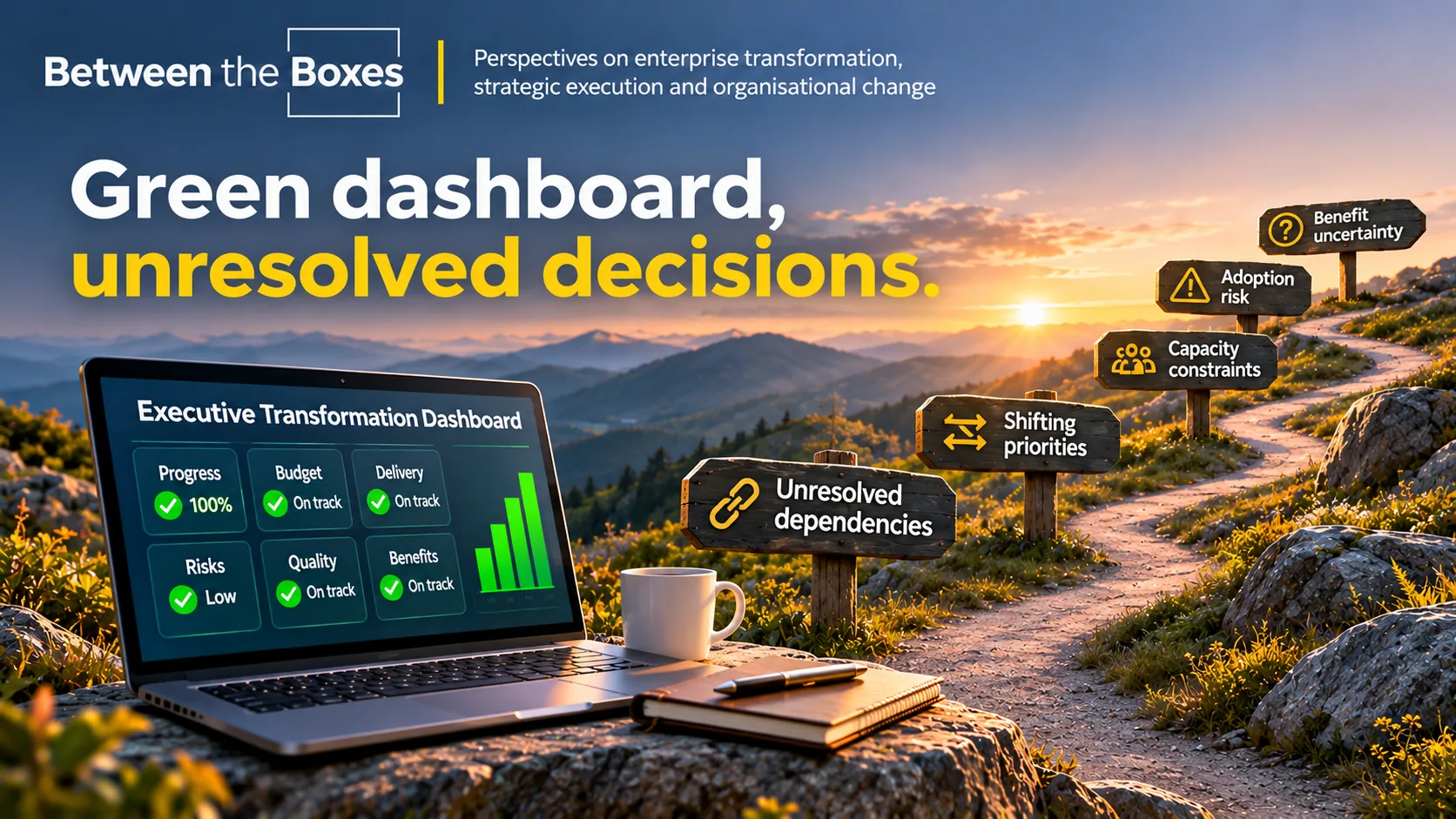
Consider a hypothetical enterprise transformation involving technology modernisation, process redesign and organisational change.
Each workstream reports green. The technology team is delivering its scheduled releases. The process team is completing its designs. Training activities are meeting their planned milestones.
Yet the future operating model requires shared capabilities that have not been prioritised across the organisation. Operational leaders have not committed sufficient capacity for adoption. Several expected benefits depend on decisions outside the authority of the programme team.
The dashboard may correctly show that the agreed work is being completed. What it may not make obvious is whether the organisation is becoming ready to use that work effectively.
A useful steering committee would ask:
- Which unresolved dependency threatens the intended business outcome?
- What decision is required, and who has the authority to make it?
- What has changed since we approved the investment?
- What would justify changing direction now?
- Which expected benefits have credible evidence, and which remain assumptions?
Those questions move the conversation from reporting performance to governing transformation.
From reporting discipline to decision discipline
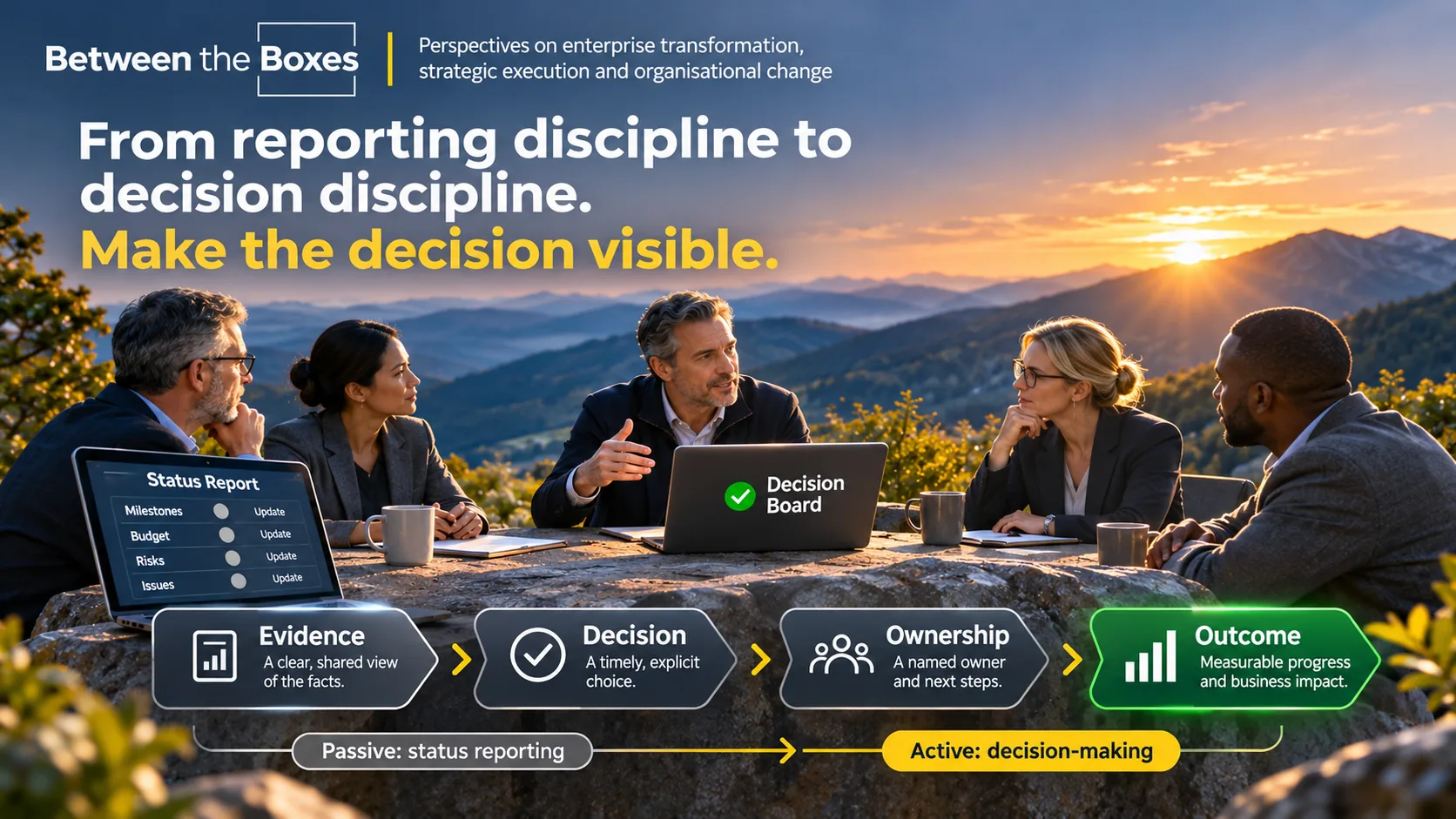
Improving governance does not necessarily mean producing more reports, introducing another framework or expanding the number of steering meetings. It means making the connection between evidence and decisions more explicit.
Make the decision visible. Every material issue should identify the choice that needs to be made, rather than merely describe the problem.
Give decisions an accountable owner. A committee can provide collective oversight, but unresolved decisions still need clear authority and accountability.
Expose assumptions and trade-offs. Decision-makers need to understand what the available evidence supports, what remains uncertain and what alternative courses of action would mean.
Revisit the business rationale. An approved business case is a starting point, not permanent proof that the original investment remains the best choice.
Follow decisions through to outcomes. A decision has little value if it is not translated into coordinated action, operational ownership and observable results.
None of this replaces reporting. It makes reporting more useful.
The question I would put to the steering committee
At the next transformation review, imagine setting aside the dashboard for a moment. Ask every decision-maker:
What is the most important decision we need to make now to improve the probability of achieving our intended business outcomes?
Then ask: What evidence would make us change that decision?
If these questions produce clarity, the governance process is doing more than monitoring activity. If they produce silence, more reporting may not be the answer. It may be time to examine how decisions are actually made.
The real measure of transformation governance
A green dashboard is useful. But it is not a certificate of sound judgement, strategic relevance or realised value.
The purpose of governance is not to preserve the appearance of control. It is to enable informed choices, timely intervention and accountable execution when circumstances change.
Effective transformation leaders ask whether the plan still makes sense, whether required decisions are being made and whether those decisions are improving the outcomes that matter.
Because a transformation can have perfect reporting and still make poor decisions.
And the real cost is not the reporting. It is the opportunities lost while the organisation continues confidently in the wrong direction.
Sources and further reading
- Project Management Institute, Pulse of the Profession 2026.
- National Audit Office, Governance and decision-making on mega-projects.
- Association for Project Management, Benefits management and project success.
- Association for Project Management, From evidence to action.
Milo Izzinosa
Enterprise Transformation & Execution Lead
Founder, eXcelleRes
What is one decision your transformation reporting makes visible, but your governance process still struggles to make?
 English
 Nederlands
 Português